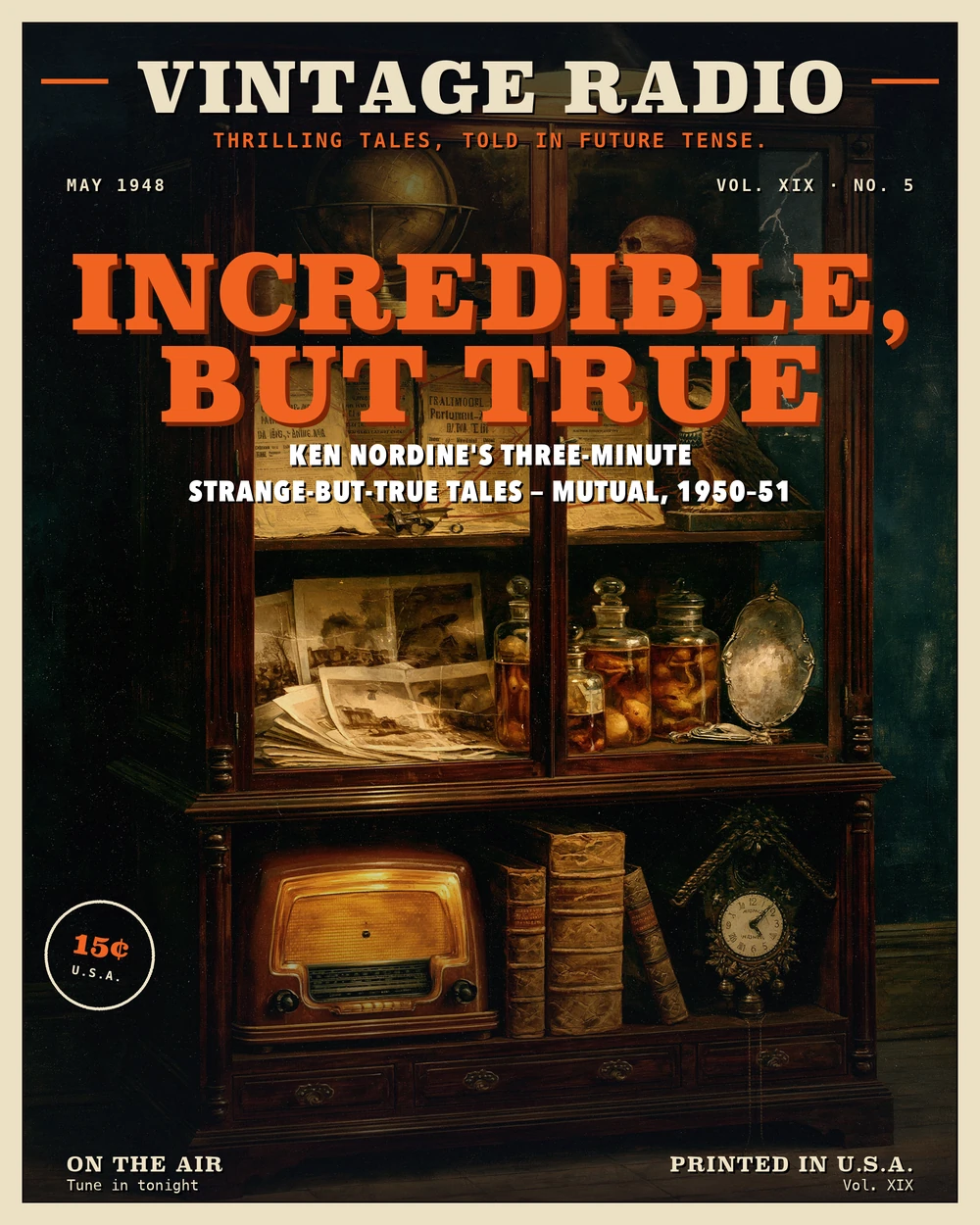
Incredible, But True
Three Minutes of the Strange
What made Incredible, But True unusual even by old-time radio standards was its format. Most of the 80 surviving episodes run about three minutes — dramatized, narrated, complete. That's not a teaser or a cold open; that's the whole story. Produced by Unusual Features Syndicate and distributed on Columbia transcriptions, the series aired on the Mutual Broadcasting System from 1950 to 1951, presenting accounts from around the world that hovered at the edge of the explainable. Scientifically improbable events, tales of apparent insanity, encounters with the spirit world, journeys backward through time — each one packaged in a tight, theatrical miniature.
The show actually existed in two formats. A 15-minute version ran on Tuesdays and Thursdays at 9:30 PM from April 17, 1950 through June 5, 1951, and on Saturdays at 5:15 PM from June 30 through December 22, 1951, according to Jay Hickerson's The Ultimate History of Network Radio Programming and Guide To All Circulating Shows. The 80 episodes that survive are the shorter, three-minute versions, and most are reported to be in excellent condition.
Ken Nordine at the Center
The series was built around a single voice: Ken Nordine, whose deep baritone gave each episode its sense of controlled unease. Nordine started in radio in 1938 at Chicago's WBEZ, worked as an announcer in Florida and Michigan, and had returned to Chicago by the time Incredible, But True went on the air. The show was part of his early career, well before he became known for his Word Jazz recordings. Here he worked as host and narrator, framing each dramatized story and giving the material its tone. The writers and cast handled the dramatizations; Nordine provided the atmosphere that held it together.
How It Sounded
The production leaned on minor-key organ chords to set a theatrical, mysterious mood — a standard tool of radio suspense, but applied in concentrated doses given how short each episode was. Sound effects accompanied the organ, and a small cast performed each story's dramatization. The writers occasionally adjusted the endings of real accounts to sharpen the dramatic effect, which put Incredible, But True somewhere between documentary and drama. The framing was always that these things had actually happened, or at least been reported as real — the show's closest conceptual relative was Ripley's Believe It Or Not, which had run from 1930 to 1948.
The Episodes
Episode titles give a sense of the range: "The Wolf on Bald Mountain," "Room 117," "Pray for Me," "Three Who Died," "You Tell Me Your Dream," "The Baming Spirit," and "The Doctor Pays a Call." Some lean toward the ghostly, some toward the medically or psychologically strange, some toward the simply improbable. Eighty of these survive, a substantial slice of what was produced across both broadcast formats. The catalog is categorized under "Information/Entertainment" — a reasonable label for a show that committed to the factual frame while delivering something closer to a campfire story.